Open a queue that is already ranked.
Post a role once. Every application that arrives is read against it on six weighted factors and lands in order of fit — with the sentence that put it there attached. Nobody is rejected before a person has looked.
Найм на Nebryx
One board, from the advert to the offer.
Write the role, publish it when it reads right, and work the queue Aria orders for you. When the queue is thin, search the wider pool against the same role — without a single name or contact detail changing hands until somebody applies.
Required and nice-to-have, kept apart.
A role is a draft until you publish it, so a mistyped band never goes live the moment somebody hits save. Nothing about it is visible to anyone in the meantime.
The two skill lists are separate fields because they are scored differently: required skills gate the total, nice-to-haves only lift it. Collapsing them into one wish list is what makes most adverts impossible to judge.
Разместить вакансию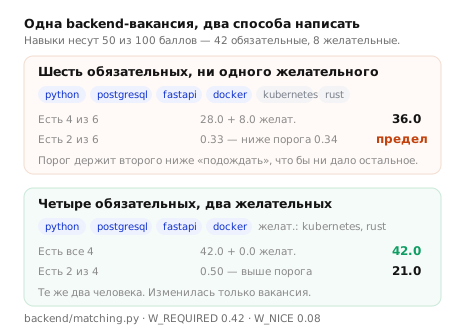
In order before you opened it.
Applications are scored on arrival, not when you get round to them, so the list is already sorted the first time you see it. Open any row and the six factors are listed with the sentence that set each one.
The same profile against the same role produces the same number today and next month. Nothing drifts because a model was updated underneath you.
How Aria scores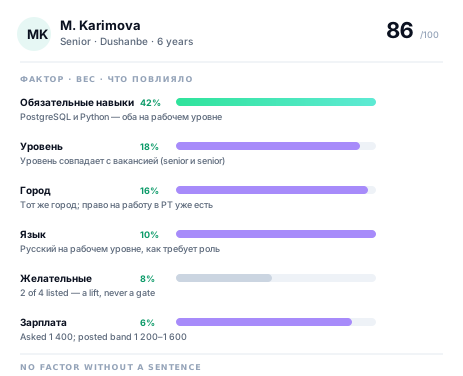
A quiet week is not a dead end.
Aria ranks the searchable pool against your role as well as the people who applied to it, so an advert nobody has found yet still gives you somewhere to start.
Those results carry no name, no handle and no contact details — only the signal you need to judge fit. Identity is exchanged when an application connects the two of you, and not before.
Talent intelligence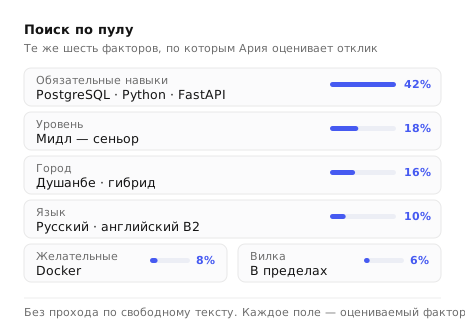
Five countries, one posting.
Tajikistan, Uzbekistan, Kazakhstan, Kyrgyzstan and Turkmenistan sit on the same board. Right-to-work status is a field a candidate fills in per country, and the location factor reads it — so “would need sponsoring” and “already permitted” never score the same.
Russian, English, Tajik, Uzbek and Kazakh are scored at the level the role actually asks for, rather than as a checkbox.
Right to work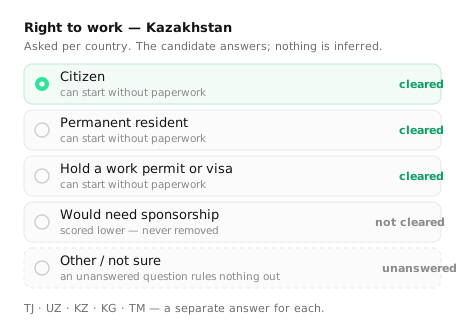
Six factors, and what each one is worth.
Not a black box and not a percentage match. These are the weights the scorer applies to every application on the board — the same six, in the same proportion, for every employer.
Below a third of the required skills the total
is capped whatever else scores, so a strong showing on location and language cannot
float a candidate over the line who does not have the job’s actual skills.
Read from backend/matching.py at load.
the score at which Aria recommends connecting — a recommendation, never an action
candidates rejected without a person deciding — there is no setting that changes this
countries on one board, each with its own right-to-work field
Четыре вещи, которые не настраиваются.
No automated rejection. No contact details in search. No score shown to the candidate. No per-employer weight tuning. There is no plan and no contract that changes any of them.

Разместите один раз. Откройте очередь, которая уже выстроена.
Free while we pilot across Central Asia. We onboard early clients ourselves.
You’ve likely got a few questions.
What does it cost?
What does it cost?
Nothing, while we are piloting across Central Asia. We onboard early clients personally, and you will hear about pricing from us long before it applies to you.
It is free for jobseekers permanently — that side is not a trial.
Does Aria reject anyone automatically?
Does Aria reject anyone automatically?
No. It produces an ordering and a recommendation; a person acts on it. No candidate receives an outcome that a human did not choose to send, and there is no setting that turns this off.
Can I see contact details from search?
Can I see contact details from search?
No. Search results carry no name and no handle — only the signal you need to judge fit. Identity appears once an application connects the two of you.
Anyone who registered a company would otherwise be able to copy the whole candidate list, which in this market is the entire asset.
How are skills matched?
How are skills matched?
Through an explicit alias table, not fuzzy matching. Edit distance pairs java with javascript, which is exactly what makes an automated shortlist untrustworthy. The table also covers regional paste artefacts, like a Cyrillic с in 1с.
Can I tune the weights for my company?
Can I tune the weights for my company?
No, and that is deliberate. Per-employer weights are how a scorer quietly becomes a proxy for preferences that have no business being scored. Every role on the board is read the same way.
What you do control is the role itself: which skills are required rather than nice to have, the band, the languages, the city and the work mode.
Which countries does it cover?
Which countries does it cover?
Tajikistan, Uzbekistan, Kazakhstan, Kyrgyzstan and Turkmenistan, from one board. A candidate records their right-to-work status per country, and the location factor reads it rather than guessing from where they live.
What happens to a CV that arrives by email?
What happens to a CV that arrives by email?
The same thing that happens to one submitted through the board: it is read, scored on the same six factors, and joins the same queue. A role has its own inbound address, and a Gmail account can be connected so forwarded applications land there too.
Everything you need to hire smarter.
Talent pool
What the region’s pool actually contains by role and city — counted from the board, not estimated.
Блог для работодателей
How to read a thin queue, why a band you did not publish costs you applicants, and what the floor is for.
Центр доверия
Что мы храним, что отказываемся с этим делать и какие границы ставим на оценку людей.